
Every plant manager and CTO knows the sinking feeling of unplanned downtime. It’s the thief of productivity, stealing hours and dollars before you even know something is wrong. In the quest to eliminate downtime, three strategies dominate the conversation: Preventive Maintenance (PM), Condition-Based Maintenance (CBM), and Predictive Maintenance (PdM). While the terms are often used interchangeably, they are distinct disciplines. Choosing the wrong one can mean wasting budget on unnecessary repairs—or worse, facing catastrophic failure because you trusted a schedule over reality. Here is the breakdown of who to use, when, and why.
1. Preventive Maintenance (The "Calendar" Approach)
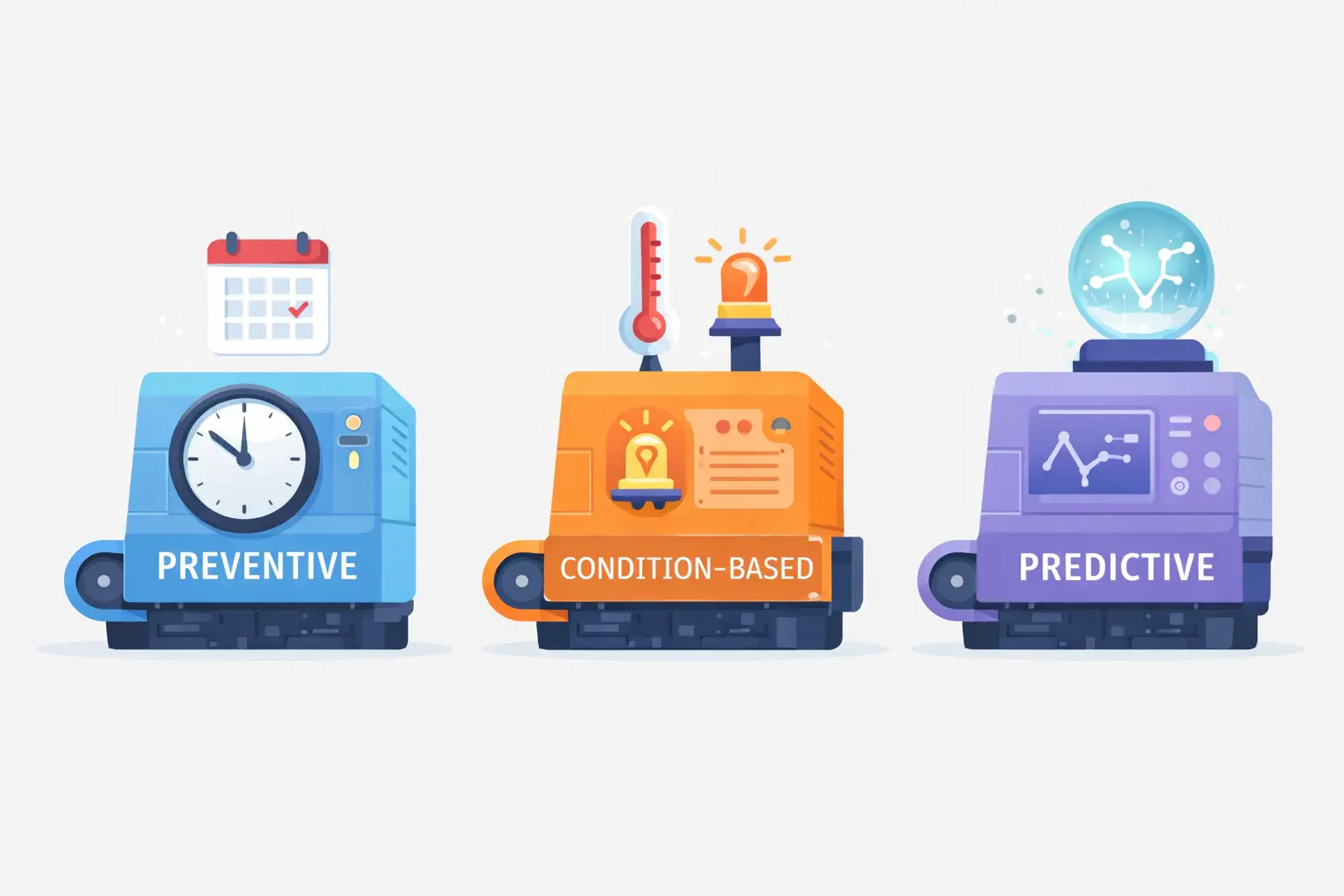
Preventive Maintenance is the classic "oil change" model. It is time-based or usage-based (e.g., "replace bearings every 12 months" or "service machine after 10,000 cycles").- How it works: You schedule maintenance intervals based on average life expectancy statistics (Mean Time Between Failures - MTBF).
- The Pro: It is easy to schedule and budget. You don't need expensive sensors or complex data analysis.
2. Condition-Based Maintenance (The "Check Engine" Approach)
Condition-Based Maintenance (CBM) moves away from the calendar and looks at the actual health of the asset. It relies on real-time monitoring of specific parameters.- How it works: Sensors monitor key indicators like vibration, temperature, pressure, or acoustic levels. Maintenance is triggered only when a specific threshold is breached (e.g., "If vibration exceeds 5mm/s, issue a work order").
- The Pro: You maximize part life because you only fix what is actually degrading. It catches issues that a calendar-based PM schedule might miss.
- The Con: It requires an upfront investment in instrumentation/sensors and requires training staff to interpret the "conditions."
3. Predictive Maintenance (The "Crystal Ball" Approach)
This is the gold standard for high-stakes environments. Predictive Maintenance (PdM) takes CBM a step further by using data analytics and Machine Learning to forecast future failures.- How it works: It doesn't just look at a single threshold (like CBM). It analyzes trends, patterns, and historical data to detect subtle anomalies. It tells you, "Based on the current degradation curve, this bearing will fail in 48 hours."
- The Pro: It offers the longest lead time before failure, allowing you to schedule repairs during planned downtime windows without disrupting production.
- The Con: It is complex. It requires high-quality historical data, data science capabilities, and a mature maintenance culture.
Comparison: The Decision Matrix
| Feature | Preventive (PM) | Condition-Based (CBM) | Predictive (PdM) |
|---|---|---|---|
| Trigger | Time or Usage count | Threshold breach | Data trend/Pattern |
| Cost to Implement | Low | Medium | High |
| Asset Life Use | Low (Replaced early) | High (Replaced on need) | Maximum (Replaced just in time) |
| Best For | Low-criticality, cheap parts | Critical assets with clear signs | High-value, complex assets |