
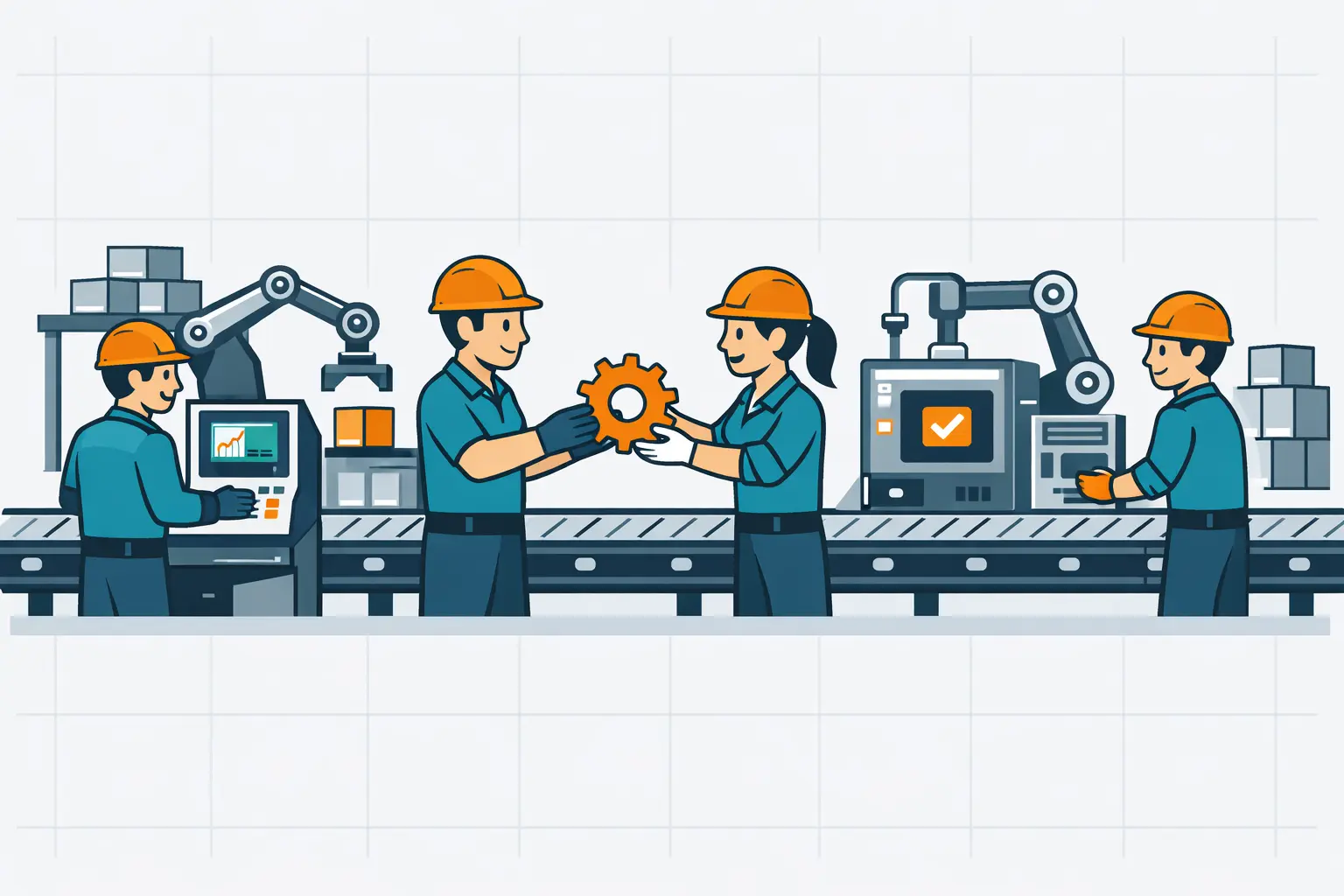
You know the feeling of walking the shop floor and seeing Station A buried in work-in-progress (WIP) while Station C operators are leaning against their benches waiting for parts. It’s the classic "hurry up and wait" syndrome. For most production heads, the knee-jerk reaction to a missed shift target is to request more headcount or authorize overtime. But often, the problem isn’t a lack of hands—it’s that the hands you have aren't moving in sync. Inefficient line balancing acts like an invisible brake on your entire operation, turning your high-speed equipment into expensive paperweights.
The "Hidden Factory" Within Your Line
Line balancing fails when the work content at each station isn’t distributed according to Takt time (the rate at which you must complete a product to meet customer demand). When one station takes seconds and the next takes seconds, you aren't just losing seconds; you are creating a permanent bottleneck that dictates the speed of the entire plant. This imbalance leads to:- Erratic WIP accumulation: Parts pile up, taking up floor space and increasing the risk of damage.
- Operator Burnout: Some workers are perpetually stressed, while others are disengaged.
- Poor Quality: Rushed operators at bottleneck stations are statistically more likely to skip a check or miss a torque spec.
The Business Impact: Beyond Just "Busy Work"
Inconsistency on the line hits your KPIs where it hurts most:4 Line Balancing Hacks for Immediate Throughput
#### 1. The "Work Element" Shredder Don't look at a station as one big task. Break it down into "micro-elements" (e.g., picking up a screw, applying grease, walking to the bin).- The Hack: Move a -second "pick and place" element from a heavy station to a light station. It sounds trivial, but across units a shift, that’s over minutes of reclaimed time.
- The Hack: Post this chart on the shop floor, not in the office. When operators see that their station is "over the line" (exceeding Takt), they are often the best people to suggest which small task can be offloaded to a neighbor.
- The Hack: Minimize the "Non-Value Added" (NVA) movement. Use "Point of Use" tooling so every operator, regardless of height or reach, performs the task in the same spatial footprint.
- The Hack: Create a "Bumping" system where operators move to the work, rather than waiting for the work to move to them.
Realistic Scenario: The Sub-Assembly Struggle
Imagine an electronics assembly line.- Station A (Prep): seconds.
- Station B (Soldering): seconds (The Bottleneck).
- Station C (Testing): seconds.
Identifying the Gaps in Real-Time
The hardest part of line balancing isn't the math; it’s the data. If you are relying on a supervisor with a stopwatch once a month, you are seeing a "staged" version of reality. To truly balance a line, you need to know exactly when and where the micro-stops are happening. Our downtime tracking software at [Startup Name] allows production leads to see station-by-station performance in real-time. Instead of guessing where the bottleneck is, the data highlights exactly which station is lagging behind the Takt time, allowing you to re-balance on the fly.The Takeaway
Throughput is a function of flow, not effort. You don't need people to work faster; you need the work to be distributed better. If you can shave seconds off your bottleneck station by shifting tasks, you’ve effectively hired a "virtual worker" for free. Next Step: Pick one line this week. Use a stopwatch to time three consecutive cycles at every station. If the gap between your fastest and slowest station is more than , you have a massive opportunity for an "instant" throughput boost.Want to see where your line is actually losing time? [Link: Download our "10-Minute Bottleneck Finder" Checklist]